DeepSeek: The Chinese AI App That’s Got the World Talking – and US Tech Giants Trembling
The technology industry has been left reeling after the sudden emergence of DeepSeek, a new Chinese AI app. The app’s rapid rise to prominence has shaken the markets and challenged America’s perceived superiority in the field of artificial intelligence (AI). As venture capitalist Marc Andreessen noted, “DeepSeek-R1 is AI’s Sputnik moment,” referencing the satellite that sparked the space race.
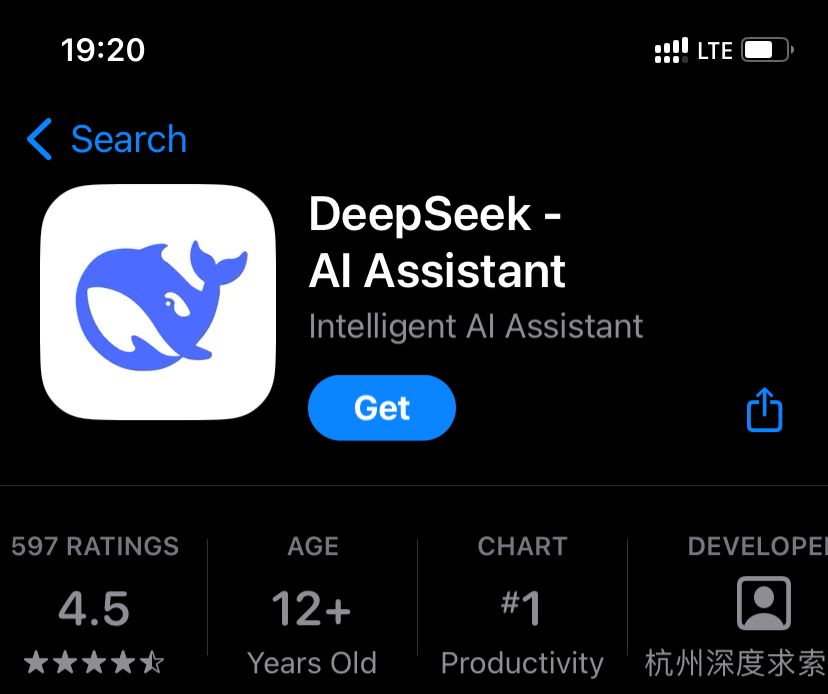
DeepSeek’s impact was swift and decisive. By the end of the weekend, it had become the most downloaded free app on Apple’s US App Store. On Monday, the app triggered a massive sell-off of major tech stocks, with shares of AI chip designer Nvidia plummeting by 17%. This drastic decline resulted in a staggering loss of nearly $600 billion in market value, the largest drop in US stock market history.
The primary factor contributing to this seismic shift is cost. DeepSeek’s developers claim to have built the latest model for a mere $5.6 million, a fraction of the expenditure incurred by AI giants like OpenAI, Google, and Anthropic. This assertion has raised serious questions in Silicon Valley, with many observers wondering if DeepSeek’s figures are accurate or if the startup is being subsidized.

Gene Munster, a veteran analyst, expressed skepticism about DeepSeek’s claims. “I still think the truth is below the surface when it comes to actually what’s going on,” he stated. Munster questioned the financials cited by DeepSeek and wondered if the startup’s numbers were correct. Despite his reservations, he acknowledged that DeepSeek’s sudden arrival is a “flex” by China and a “black eye for US tech.”
The timing of DeepSeek’s emergence is particularly noteworthy, coming on the heels of a news conference featuring OpenAI’s Sam Altman, Oracle’s Larry Ellison, and President Donald Trump. The event showcased American bullishness on AI, with the announcement of Stargate, a joint venture promising up to $500 billion in private investment for AI infrastructure. However, DeepSeek’s sudden arrival has tempered this optimism, highlighting the need for the US tech industry to reassess its assumptions about AI development.
As Trump noted, DeepSeek’s emergence serves as a “wake-up call” for the American tech industry. The president welcomed the challenge, stating that finding ways to develop cheaper AI is ultimately a “good thing.” However, the implications of DeepSeek’s arrival extend beyond the tech sector. The app’s claims about its development process have also sparked debate about the future of semiconductor giants like Nvidia and the potential impact on the energy sector.

DeepSeek’s founder, Liang Wenfung, has been stockpiling graphics processing units (GPUs) through his hedge fund, High-Flyer. The company’s models have deployed H800 chips made by Nvidia, raising questions about the effectiveness of US policy restricting sales of higher-powered chips to China. As the tech sector grapples with the implications of DeepSeek’s emergence, one thing is clear: the AI race has just become a lot more interesting.
Sam Altman, OpenAI’s CEO, responded to DeepSeek’s arrival with a mix of admiration and competitive spirit. He described DeepSeek as “impressive… particularly around what they’re able to deliver for the price.” Altman welcomed the challenge, stating that OpenAI would “deliver much better models” and that the arrival of a new competitor was “invigorating.” As the AI landscape continues to evolve, one thing is certain: the world will be watching with bated breath.