Donald Trump Elected US President; Takes Back White House
Donald J. Trump has emerged victorious over Vice President Kamala Harris, capitalizing on widespread concerns regarding inflation and illegal immigration to usher in a style of governance reminiscent of strongman politics to the White House. This victory marks a historic moment, as he becomes the first former president in over 120 years to secure a second term following a defeat in a previous election.
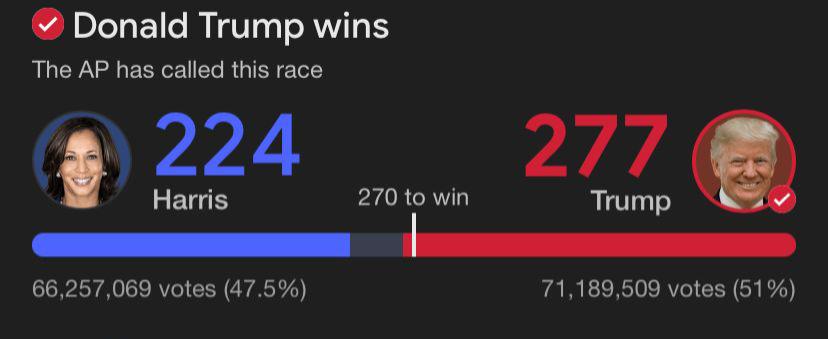
The results revealed Trump defeating Vice President Harris in a contest that was less competitive than anticipated, as he secured wins in crucial battleground states. His victory in Wisconsin, following earlier successes in Georgia, North Carolina, and Pennsylvania, allowed the former president to surpass the necessary threshold of 270 Electoral College votes needed to claim the presidency in Tuesday’s election.
Currently, Trump holds 277 electoral votes compared to Harris’s 224, thanks to his triumph in these pivotal swing states. Voters gravitated toward Mr. Trump, viewing him as the stronger leader during these uncertain times and recognizing him as a proven champion of the economy. They seemingly overlooked his 34 felony convictions, his involvement in inciting an assault on the Capitol, and the various indictments related to attempts to undermine the 2020 election and retain classified documents.
Having navigated one of the most chaotic campaigns in recent history—marked by two failed assassination attempts—Mr. Trump, at the age of 78, has become the oldest individual to be elected president. In the early hours following his victory, he addressed supporters in Palm Beach, Florida, proclaiming, “This will forever be remembered as the day the American people regained control of their country.”
As he prepares to return to Washington, he does so with his party firmly in command of the Senate after four years in the minority, which will facilitate his efforts to appoint loyalists to his cabinet and other high-ranking government positions. Meanwhile, Republicans are still working to maintain their narrow majority in the House of Representatives. The outcome of this struggle could significantly influence the extent to which Mr. Trump can pursue his legislative agenda, although he has committed to advancing many of his plans regardless of Congressional approval.
For Ms. Harris, her ambition to make history as the first woman, and additionally as the first Black and Asian American woman to attain the presidency, was encapsulated in a fierce three-month campaign that kicked off following President Biden’s decision to withdraw from the re-election race amid mounting pressure.
Ultimately, the challenges posed by post-pandemic inflation, escalating housing costs, and general economic uncertainty proved insurmountable for her campaign.
Mr. Trump, on the other hand, anchored his campaign on the promise of securing the U.S.-Mexican border and the mass deportation of undocumented immigrants. He vowed to implement sweeping tariffs aimed at bolstering domestic industries. In the closing weeks of the election, he unleashed a wave of costly financial pledges targeting various voter demographics, including the elimination of taxes on tips, overtime pay, and Social Security benefits.
His final campaign message focused on attributing all the perceived shortcomings of the unpopular Biden administration to Ms. Harris, encapsulated in the slogan, “Kamala Broke It. Trump Will Fix It.” With polls indicating a strong desire for change among voters, this narrative—coupled with Ms. Harris’s position as the sitting vice president—ultimately paved the way for his victory.
The tumultuous election of 2024 was characterized by widespread voter discontent with the anticipated nominees from both parties, Mr. Trump and Mr. Biden. Many voters viewed both candidates as too old, with neither representing a new beginning for a nation fatigued by conflict, division, and economic instability.
However, in June, during their inaugural presidential debate, Mr. Biden faltered significantly, presenting as aged and at times incoherent. Just two weeks later, Mr. Trump endured an assassination attempt in Butler, Pennsylvania, which bolstered his image as a seemingly indestructible leader, further fueled by dramatic images of him with blood on his face, raising his fist and shouting, “Fight, fight, fight.”
As he approached the Republican convention that month, Mr. Trump enjoyed a clear and expanding lead in the polls, setting his sights on a potential landslide victory in November.
Mr. Biden’s decision to withdraw from the race merely three days after the convention triggered a wave of relief and renewed enthusiasm among Democrats for Ms. Harris, effectively resetting the electoral landscape and transforming it into what was anticipated to be one of the closest races in modern American history.
Ms. Harris, with the support of numerous Republicans, including many former members of Mr. Trump’s administration, sought to highlight what she characterized as his authoritarian tendencies and bigoted inclinations, framing him as a genuine threat to democracy. In the final weeks of the campaign, she and her allies began labeling him a fascist, especially as Mr. Trump’s campaign rhetoric grew increasingly dark, menacing, and xenophobic.
Many advertisements from the Trump campaign or its supporters relied heavily on alarming imagery, showcasing migrants surging across the border, mug shots of Hispanic criminals, and overt hostility toward transgender individuals, all designed to evoke fear and foster distrust. The former president disparaged the vice president, branding her as lazy, stupid, and “dumb as a rock.”
The aggressive tone of his rhetoric escalated as well. He made ominous promises of a “bloody story” involving the mass deportation of criminal aliens, suggested that police should be given free rein for “one rough hour” to combat crime, and stated he would deploy the military against what he termed “the enemy from within.” In the closing days of his campaign, he even proposed that one of his staunchest Republican critics, former Representative Liz Cheney, should be placed on a battlefield “with nine barrels shooting at her.”
Despite this barrage of incendiary language and threats, none of it significantly undermined his appeal, which remained anchored in his promise of an American “comeback” under his leadership.