Nepal: Social Media Ban Sparks Deadly GEN Z Protests, Claims 22 Lives, Including Former PM’s Wife
In a shocking turn of events, Nepal has been gripped by chaos following violent protests over a controversial social media ban, culminating in the tragic death of Rajyalakshmi Chitrakar, the wife of former Nepalese Prime Minister Jhalanath Khanal, a brutal attack on Finance Minister Bishnu Prasad Paudel, who was chased into a river by an angry mob, and an assault on another former prime minister, Sher Bahadur Deuba, who was beaten at his home before being rescued by security forces. The unrest, driven by widespread frustration over government policies and corruption, has left the Himalayan nation reeling, with at least 22 fatalities, multiple prison breaks freeing hundreds of inmates, and a political crisis that has forced the resignation of Prime Minister K.P. Sharma Oli.
The protests erupted after the Nepalese government imposed a ban on 26 major social media platforms, including Facebook, Instagram, WhatsApp, 𝕏, and YouTube, on September 4, 2025. The government justified the move by citing the platforms’ failure to register with the Ministry of Communication and Information Technology and comply with local oversight regulations. A proposed bill to regulate social media further fueled public outrage, with critics, including rights groups, decrying it as an attempt to curb freedom of expression and silence dissent.

For Nepal’s youth, who make up nearly 43% of the population and heavily rely on digital platforms for communication and activism, the ban was a direct assault on their voices. The move came at a time of growing discontent, with social media campaigns—particularly on TikTok—highlighting the lavish lifestyles of politicians’ families against the backdrop of Nepal’s economic struggles, where the per capita income is just $1,447.
On September 8, 2025, thousands of mostly young protesters, dubbed the “Gen Z movement,” took to the streets of Kathmandu and other cities, demanding the reversal of the social media ban and an end to systemic corruption. The demonstrations quickly turned violent as police clashed with crowds attempting to storm the Parliament building. Reports indicate that police used tear gas, water cannons, and live ammunition, resulting in at least 19 deaths on the first day alone, with over 100 injuries.

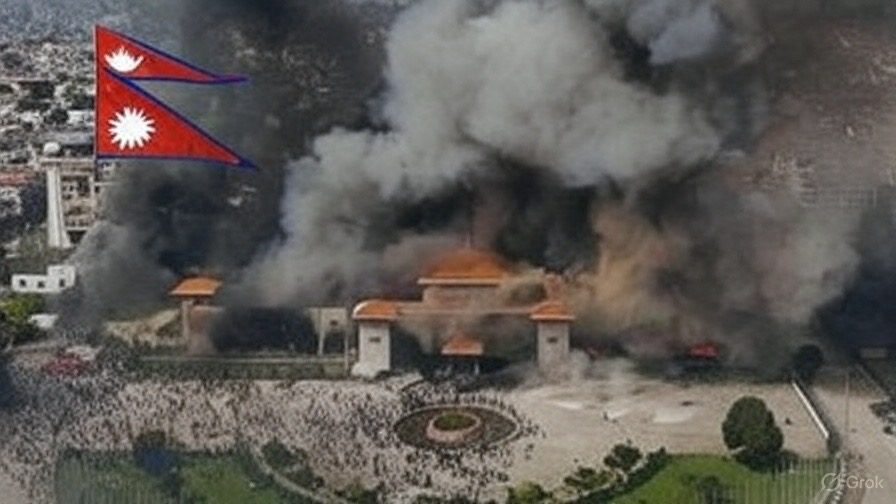
The violence escalated on September 9, despite the government lifting the social media ban in response to public pressure. Defying curfews, protesters targeted the homes of prominent political figures, setting fire to residences of leaders like Sher Bahadur Deuba of the Nepali Congress, President Ram Chandra Poudel, and former Prime Minister Pushpa Kamal Dahal. The parliament building itself was also torched, and Tribhuvan International Airport in Kathmandu was partially closed due to security concerns. Adding to the chaos, protesters stormed several prisons, leading to mass jailbreaks. At Nakkhu Prison in Kathmandu/Lalitpur, former Deputy Prime Minister Rabi Lamichhane and approximately 1,500 other inmates escaped after protesters forced police to withdraw. Similar incidents occurred in Pokhara, where 773–900 inmates fled, Tulsipur Jail in Dang Province, where 127 prisoners escaped, and Dhangadhi, where hundreds more were freed, raising significant security concerns.
Amid the chaos, a particularly devastating incident occurred in Dallu, where protesters allegedly set fire to the home of former Nepalese Prime Minister Jhalanath Khanal. Rajyalakshmi Chitrakar, his wife, was reportedly dragged into the house by demonstrators before it was engulfed in flames. She suffered severe burns and was rushed to Kirtipur Burn Hospital in critical condition but succumbed to her injuries.

In a separate but equally alarming incident, Finance Minister Bishnu Prasad Paudel, aged 65, was violently attacked by protesters in Kathmandu. Viral videos circulating on social media captured the minister being chased through the streets by an angry mob. In one disturbing clip, a young protester kicked Paudel, causing him to crash into a wall. As he scrambled to his feet, the mob pursued him relentlessly, chasing him into a river in a desperate attempt to escape. The footage underscored the intense public rage directed at government officials, fueled by frustrations over corruption, unemployment, and political privilege.

Adding to the turmoil, former Prime Minister Sher Bahadur Deuba and his wife, Foreign Minister Arzu Rana Deuba, were assaulted by protesters who stormed their residence and set it ablaze. Deuba sustained visible injuries, appearing bloodied in circulating videos, and the couple required intervention by the Nepalese Army to be escorted to safety.
The protests’ intensity, the mounting death toll, and the widespread prison breaks prompted swift political consequences. Prime Minister K.P. Sharma Oli, facing growing unpopularity, announced his resignation on September 9, hours after promising an investigation into the violence. Home Minister Ramesh Lekhak also stepped down late on September 8 following an emergency cabinet meeting. The government’s decision to lift the social media ban was an attempt to quell the unrest, but protesters, fueled by broader grievances over corruption and nepotism, remained unappeased.

The United Nations, through Resident Coordinator Hanaa Singer-Hamdy, expressed alarm at the violence, calling for restraint and unrestricted medical access for the injured. Amnesty International condemned the use of live ammunition against protesters, and the UN has offered assistance to address the crisis.
The protests in Nepal are not just about a social media ban; they reflect deep-seated frustrations with governance, economic inequality, and political corruption. With unemployment at 10% and a youth population eager for change, the unrest has exposed a generational divide and a demand for accountability. As Prateek Pradhan, editor of Baahrakhari, noted, “Protests over the social media ban were just a catalyst. Frustrations over how the country is being run have long been simmering under the surface.”